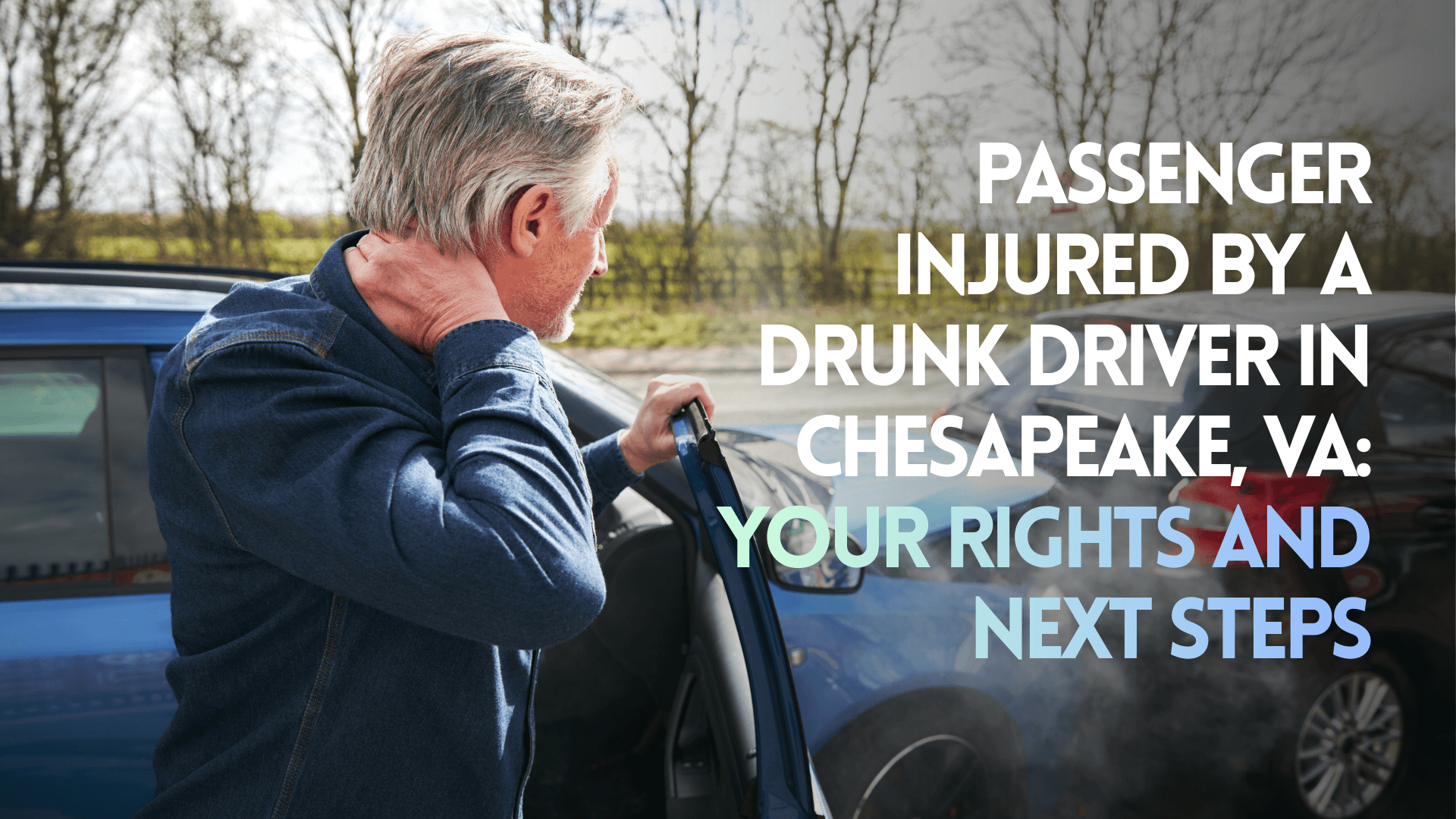
Being a passenger in a drunk driving crash is a special kind of frustrating. You did not choose the speed, the route, or the decisions that led to the collision. Yet you can still end up with the pain, the bills, the missed work, and the awkward phone calls from insurance companies.
If you were injured as a passenger in a drunk driving accident in Chesapeake or anywhere in Hampton Roads, here’s what matters most: passengers often have strong injury claims, but the insurance puzzle can get complicated fast. Knowing your rights and the right next steps can protect your health and your ability to recover fair compensation.
Why Passenger Claims After DUI Crashes Can Get Complicated
When you are a passenger, there may be multiple insurance policies in play, such as:
- The drunk driver’s auto insurance (if you were riding with the drunk driver)
- The other driver’s auto insurance (if another driver caused or contributed to the crash)
- The vehicle owner’s insurance (if different from the driver)
- Your own uninsured or underinsured motorist coverage (UM/UIM), depending on the facts and coverage
Add injuries, medical treatment, missed work, and competing stories about fault, and you can see why “just file a claim” turns into a maze.
First Things First: Protect Your Health and Your Record
Get checked out, even if the pain feels manageable
Passengers commonly walk away thinking, “I’m fine,” then wake up the next day with neck pain, back pain, headaches, or dizziness. If you have any symptoms, get medical care as soon as possible. Early documentation matters for two reasons:
- Health comes first.
- It creates a timeline that links your injuries to the crash.
Start a simple injury log
Keep it basic and consistent:
- Where it hurts, how it affects daily life, what makes it worse
- Missed workdays and restrictions
- Sleep issues, headaches, anxiety, or “brain fog”
- Appointments, referrals, and treatment plans
It is not about exaggerating. It is about not forgetting.
Save the boring paperwork
The “boring” stuff is often the most valuable later:
- Discharge instructions and visit summaries
- Bills, receipts, and prescription records
- Wage and attendance records from work
- Photos of bruising, swelling, or limited mobility
Your Rights as a Passenger in a Drunk Driving Crash
In general, injured passengers have the right to pursue compensation when another person’s negligence causes harm. In DUI crashes, that negligence is often clear, but the claim still depends on evidence and documentation.
You may have a claim even if the drunk driver is a friend or family member
This is one of the biggest emotional barriers for passengers. People worry they are “suing” someone they know.
Most injury claims are paid by insurance, not out of someone’s pocket in a direct, personal way. The real conflict usually comes from the insurance process, not from the relationship. That said, every situation is personal, and it is okay to feel conflicted. A consultation can help you understand options before you decide anything.
You may have more than one path to recovery
Depending on how the crash happened, a passenger may be able to pursue a claim through:
- The drunk driver’s liability coverage
- Another driver’s liability coverage
- UM/UIM coverage if the at-fault driver is uninsured or does not have enough coverage
- Other available coverage depending on the circumstances
The “right” path depends on the facts and the policy language, so it is worth getting the full picture before committing to a strategy.
Common Passenger Scenarios and What They Mean
Scenario 1: You were riding with the drunk driver
If you were a passenger in the drunk driver’s vehicle, the claim often focuses on that driver’s negligence. The challenge is not usually proving the driver made bad decisions. The challenge is navigating coverage, documenting injuries, and avoiding mistakes that insurers use to reduce or deny claims.
Important note: the insurance company may still try to minimize the crash or your injuries, even when DUI is involved.
Scenario 2: You were a passenger in another vehicle hit by a drunk driver
This often feels more straightforward emotionally because the drunk driver is clearly “the other person.” Practically, it still requires proof of:
- How the crash happened
- The extent of your injuries
- Your financial losses and future needs, if any
If there is a dispute about who caused the collision, passengers can get caught in the middle. That is where evidence and early documentation are critical.
Scenario 3: Multiple vehicles, multiple insurers, multiple stories
Chain-reaction crashes can trigger finger-pointing. Passengers are rarely at fault for how a crash happens, but insurance companies may still try to complicate things by disputing sequence, impact points, and causation of injuries.
What Not to Do: Mistakes That Can Hurt Passenger Claims
Don’t assume the criminal DUI case automatically “wins” your injury claim
A DUI arrest or charge can help establish facts, but a civil injury claim still needs proof of damages. Medical documentation and consistency matter.
Don’t give a recorded statement without thinking it through
Insurance adjusters may ask for recorded statements early. As a passenger, it can be easy to talk casually and accidentally create confusion:
- Guessing about speed
- Speculating about what the driver “must have done”
- Minimizing symptoms
- Trying to be “helpful” when you are still shaken up
If you are unsure, it is okay to pause and get guidance before you speak on the record.
Don’t let treatment gaps create an opening
When there is a long gap in medical care, insurers often argue the injury was not serious or was caused by something else. Follow medical advice and keep appointments when possible. If you have to miss care because of cost, transportation, or scheduling, document the reason.
The Insurance Question Passengers Always Ask: “Whose Policy Pays?”
The frustrating but honest answer is: it depends on the facts, coverage, and how fault is established.
The drunk driver’s liability coverage
This is often the starting point when the drunk driver is at fault. But policy limits can be surprisingly low compared to real-world injuries.
The other driver’s liability coverage
If another driver contributed to the crash, that driver’s policy may also be involved.
UM/UIM coverage when the at-fault driver cannot pay enough
If the drunk driver is uninsured or underinsured, UM/UIM coverage can become a key part of the case. This is also where people get blindsided, because it may involve a claim through a policy connected to you or the vehicle you were in. Even then, it is still an insurance claim, and it may still be contested.
Can a Passenger Be Blamed in Virginia?
Passengers are usually not responsible for causing a crash, but insurers may still look for angles to reduce what they pay. Examples include:
- Statements suggesting you “knew” the driver was intoxicated and chose to ride anyway and “assumed the risk” of getting injured
- Social media posts that make injuries look smaller than they are
This is not meant to scare you. It is meant to explain why being careful with statements and documentation matters.
What Compensation Can an Injured Passenger Recover?
Every case is different, but common categories include:
- Medical expenses (past and potentially future)
- Lost wages and lost earning capacity
- Pain and suffering
- The impact on daily life (sleep, mobility, childcare, driving, work tasks)
The strength of a claim often comes down to medical documentation, credible timelines, and clear evidence linking the injuries to the crash.
When to Call a Chesapeake Drunk Driving Accident Lawyer
If any of the following are true, it is smart to talk with an attorney sooner rather than later:
- You needed ER care, imaging, or ongoing treatment
- You missed work or may miss work
- The insurance company is pressuring you for a statement
- The driver is uninsured or you suspect coverage is not enough
- The crash involves multiple vehicles and disputed fault
- Your symptoms are getting worse instead of better
Early legal help is often about preserving evidence, managing insurance communications, and protecting your claim from avoidable mistakes.
Frequently Asked Questions
Can I still file a claim if the drunk driver is someone I know?
Often, yes. Many claims are paid through insurance coverage. A consultation can help you understand options and how the process typically works.
What if I was a passenger in the drunk driver’s car and feel guilty?
Feeling conflicted is normal. You did not cause the crash, and medical bills and lost wages are real. Understanding your options does not force you into a decision. It just gives you clarity.
What if the drunk driver has no insurance?
There may still be options depending on available coverage, including UM/UIM in some situations. Coverage questions are fact-specific and worth reviewing carefully.
Do I need to wait for the DUI criminal case to finish?
Not necessarily. A civil injury claim has its own timeline and evidence needs. An attorney can explain what makes sense based on your situation.
If you were injured as a passenger in a drunk driving crash and you’re not sure which insurance applies or what step comes next, talk it through with Bordegaray Injury Law. Call 757-505-HURT (4878) or visit nbinjury.com to schedule a Free Consultation.
No Fee Until We Win.
