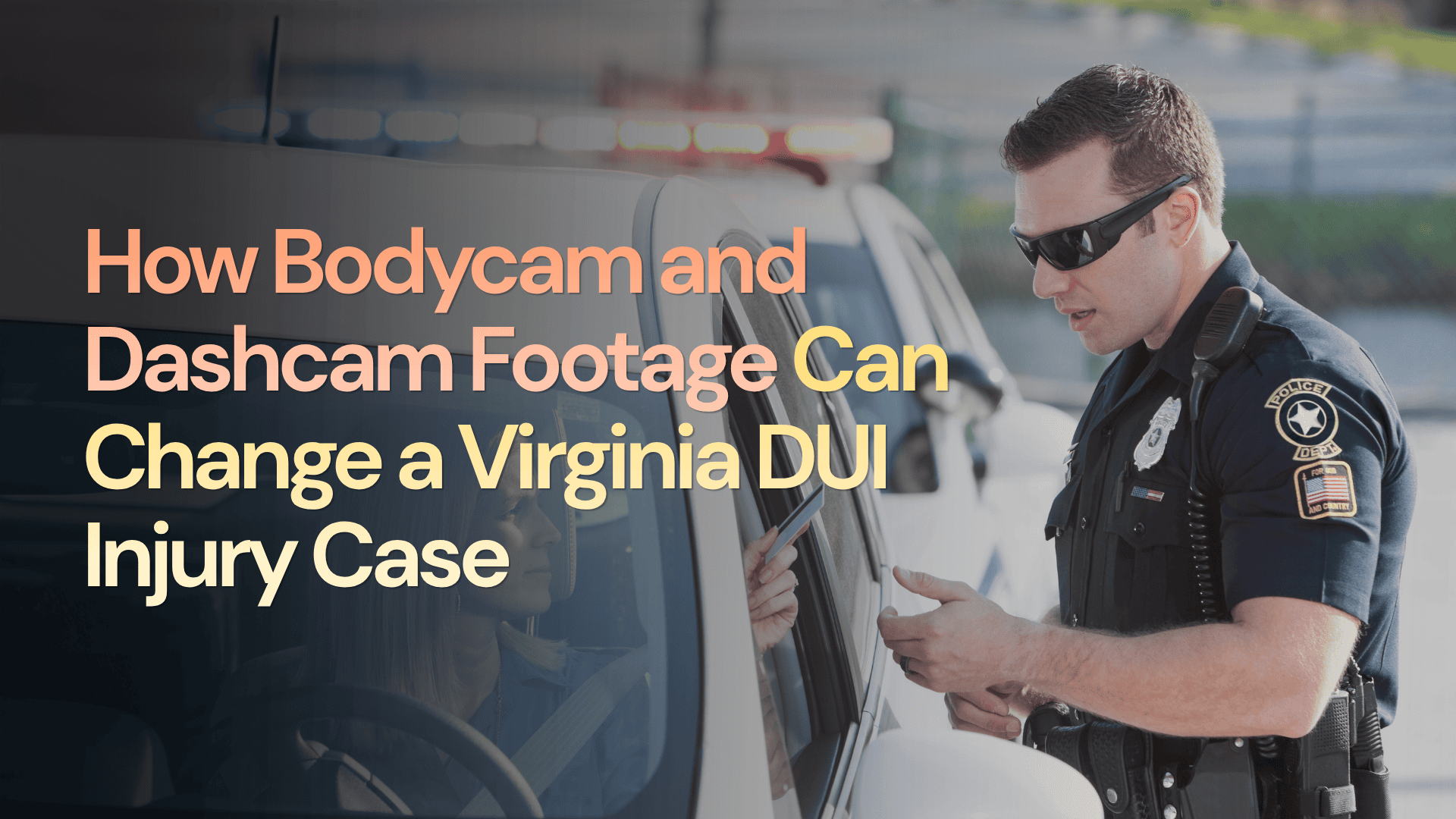
After a drunk driving crash, the police report may summarize what happened. Bodycam and dashcam footage may show it.
A recording can capture the driver’s speech, balance, behavior, admissions, field sobriety tests, and interaction with officers. It may also preserve statements from witnesses, road conditions, vehicle positions, visible injuries, and the confusion immediately following the collision.
That does not mean every recording proves the entire case. A camera may begin recording after the impact, point in the wrong direction, lose audio, or capture only part of the scene. Footage may also be unavailable, restricted, or difficult to obtain while a criminal investigation is active.
But when it exists and is preserved, video can become some of the most important evidence in a Virginia DUI injury claim.
If you were injured by a suspected drunk driver in Chesapeake, Hampton Roads, or elsewhere in Virginia, understanding how these recordings work can help protect your civil case.
Why Video Can Be More Powerful Than a Written Summary
A police report is useful, but it reflects what an officer selected and summarized in writing. Video may preserve details that do not appear in the report.
An officer might write that the driver had slurred speech or difficulty standing. Bodycam footage may allow an insurer, judge, or jury to see and hear that behavior directly.
The recording may capture the driver struggling to follow instructions, contradicting earlier statements, admitting to drinking, or appearing confused about how the collision happened. It may also show open containers, medication bottles, damage patterns, weather conditions, traffic congestion, or the location of debris.
Those details can make impairment and recklessness easier to understand. They can also prevent the story from changing after the driver has had time to speak with an insurer or attorney.
What Police Bodycam Footage May Show
Body-worn cameras are designed to create audiovisual recordings from the officer’s perspective. Virginia law recognizes body-worn camera systems as electronic systems used to create, store, display, and process these recordings.
In a DUI crash, bodycam footage may capture several important stages of the investigation.
The Driver’s Condition
The video may show whether the driver was unsteady, confused, sleepy, aggressive, slow to respond, or unable to follow instructions. It may also preserve speech patterns, unusual eye appearance, repeated questions, and other behavioral signs of impairment.
These observations may be especially important when a breath test is unavailable, the driver refused testing, or drugs may have contributed to the impairment.
Statements and Admissions
A driver may make statements before understanding their legal significance.
Examples may include admitting to drinking, identifying the bar or event they left, describing medication use, acknowledging that they should not have driven, or providing inconsistent explanations of the crash.
The exact words matter. A written police narrative may paraphrase the statement, while the recording may preserve the tone, timing, and surrounding circumstances.
Field Sobriety Testing
Bodycam may show how officers explained and administered field sobriety tests and how the driver performed.
The footage may capture balance problems, missed instructions, incorrect steps, early starts, use of arms for balance, or an inability to complete a test. It may also show environmental factors that could later become disputed, such as pavement condition, lighting, footwear, traffic, or weather.
Field sobriety footage should be evaluated carefully. It may strengthen the impairment evidence, but it must be considered alongside toxicology, officer testimony, witness observations, and the full crash investigation.
Witness and Victim Statements
Bodycam may record what witnesses said while their memories were fresh.
A witness may describe the vehicle speeding, swerving, running a light, traveling the wrong way, or nearly causing another collision before impact. The recording may also preserve the injured person’s initial description of the crash.
Early statements can be valuable, but they require context. A victim may be in pain, shocked, medicated, or confused. An incomplete statement at the scene should not automatically outweigh later evidence or medical findings.
What Police Dashcam Footage May Show
Dashcam footage generally records from a police vehicle rather than from the officer’s body.
Depending on when the officer arrived and when the camera was activated, dashcam footage may show the approach to the scene, traffic conditions, vehicle locations, emergency response, roadside sobriety testing, or the impaired driver’s behavior near the patrol car.
In some cases, an officer may observe dangerous driving before the crash or before initiating a traffic stop. Dashcam footage may then capture lane movements, speed relative to surrounding traffic, failure to stop, delayed reactions, or other conduct that supports impairment.
It is important not to assume that police dashcam recorded the collision itself. Often, the officer arrives afterward. Even then, the recording may preserve the condition of the scene before vehicles are moved and debris is cleared.
Other Video May Be Just as Important
Police recordings are only one potential source of video evidence.
A DUI crash may also be captured by a private dashcam, commercial fleet camera, rideshare camera, business surveillance system, parking lot camera, residential doorbell camera, or mobile phone.
Each source may show a different part of the event.
A business camera may record the drunk driver leaving a parking lot. A doorbell camera may show the vehicle speeding through a neighborhood. A private dashcam may capture the collision itself. A restaurant camera may show the driver’s behavior shortly before getting into the vehicle.
The strongest video case may come from combining several recordings into a reliable timeline.
Video Can Help Prove Impairment Without Replacing Other Evidence
A video may strongly suggest impairment, but it should not be treated as the only evidence needed.
A complete DUI injury investigation may also include breath or blood test results, refusal records, field sobriety notes, toxicology, 911 calls, witness statements, bar or purchase records, vehicle data, and crash reconstruction.
The goal is to connect the evidence.
For example, footage may show the driver stumbling and speaking slowly. A witness may report that the vehicle had been weaving. Event data may show no braking before impact. Toxicology may confirm alcohol or drug use.
Each piece strengthens the others. Together, they can create a clearer explanation of how impairment affected the driver’s ability to operate the vehicle safely.
Video Can Help Establish How the Crash Happened
Bodycam and dashcam evidence are not limited to proving intoxication.
The footage may show lane markings, traffic signals, weather, lighting, vehicle resting positions, debris, skid marks, damage locations, and sight obstructions. These details can help establish fault and respond to contributory negligence arguments.
Virginia’s strict contributory negligence rule gives insurers a reason to search for any alleged fault by the injured person. Even when the other driver was intoxicated, an insurer may argue that the victim was speeding, distracted, following too closely, or should have avoided the collision.
Video may help confirm that the injured driver had the right of way, was stopped, remained within the proper lane, or had no reasonable opportunity to avoid the impact.
It may also reveal facts that require additional investigation. The recording should be reviewed objectively, not only for details that support one side.
Video Can Preserve the Severity of the Scene
Some injuries are visible immediately. Others develop or become clearer later.
Bodycam may record bleeding, swelling, difficulty walking, confusion, repeated questions, distress, or the need for emergency treatment. It may also show vehicle intrusion, deployed airbags, damaged child seats, shattered glass, or the force required to move the vehicles.
This evidence can help explain why medical treatment was necessary. It can also respond to later arguments that the collision was minor.
But video of the scene does not replace medical records. The claim still needs documentation connecting the crash to the diagnoses, treatment, limitations, and future care.
Not Every Recording Is Automatically Available
One of the most important legal cautions is that bodycam and dashcam footage are not always available through a simple public-records request.
Virginia’s Freedom of Information Act provides access to public records but also contains specific rules for law-enforcement and criminal investigative records. Certain records may be withheld, redacted, delayed, or disclosed only through a particular statutory or court-supervised process. A court reviewing a request connected to pending litigation may also impose restrictions on further disclosure.
Access may depend on factors such as:
- Whether the criminal investigation is active.
- Whether the recording is part of a criminal investigative file.
- Whether disclosure could affect an investigation or prosecution.
- Whether the footage contains private or sensitive information.
- Whether a court order, subpoena, discovery request, or other legal process is required.
- Whether portions must be redacted before release.
A denial or delay does not necessarily mean the footage does not exist. It may mean a different legal process is required to obtain it.
Preservation and Access Are Different Issues
Requesting a copy of a recording and asking the agency to preserve it are not the same thing.
A person may not be entitled to immediate access while a criminal case is pending, but the footage may still need to be preserved for reasonably foreseeable civil litigation.
Virginia law states that a party or potential litigant has a duty to preserve evidence that may be relevant to reasonably foreseeable litigation. When evidence is lost after that duty arises, the court may consider remedies depending on the circumstances and degree of fault.
A preservation request should identify the crash with enough detail to help locate the material. Relevant information may include the date, approximate time, location, incident number, involved officers, vehicles, and types of recordings requested.
Preservation does not guarantee that the material will ultimately be admissible or released. It helps prevent potentially valuable evidence from disappearing before those questions are decided.
Why Timing Matters
Digital recordings are not necessarily stored forever.
Retention periods may vary by agency, recording classification, investigation status, and internal policy. Private businesses and residential camera systems may overwrite video much faster than police agencies.
This is why the first days after a crash matter.
A business may erase surveillance automatically. A private driver may record over dashcam footage. A fleet system may retain only short clips. A homeowner may delete a recording without realizing it captured relevant evidence.
The safest approach is to identify potential cameras early and send focused preservation requests before the footage is lost.
Footage Can Contain Evidence That Hurts the Claim
Video is objective only in the sense that it records what was within the camera’s range. It can still be incomplete, difficult to interpret, or unfavorable.
A recording may capture the injured person making an uncertain statement, appearing less injured than later medical records suggest, or acknowledging a fact the insurer may use to argue contributory negligence.
That does not mean the footage should be ignored. It means it should be reviewed in context.
A person who says “I’m okay” at the scene may be experiencing adrenaline and develop symptoms later. A statement about speed may be an estimate rather than a reliable measurement. A camera angle may make distance or timing difficult to judge.
The right approach is to understand the entire recording, compare it with physical evidence and medical records, and address weaknesses honestly.
Authenticity and Admissibility Still Matter
Having a video does not automatically mean it will be admitted into evidence at trial.
The party offering the recording may need to establish that it is what they claim it is and that it has not been materially altered. Other evidentiary issues may involve relevance, completeness, hearsay, privacy, redaction, or unfair prejudice.
These questions are fact-specific. The original file, metadata, chain of custody, custodian testimony, and the circumstances of the recording may all become important.
For settlement purposes, footage can still influence an insurer before a final admissibility ruling is made. Insurers often evaluate how evidence is likely to appear to a jury, not only whether every second of the recording will ultimately be shown at trial.
How Video May Affect Punitive Damages
Punitive damages may be available in some Virginia DUI cases, but they are not automatic.
Bodycam or dashcam footage may help establish facts relevant to punitive damages, including severe impairment, refusal-related circumstances, admissions, dangerous driving, extreme speed, wrong-way operation, or other conduct showing conscious disregard for safety.
The footage does not independently create a punitive damages claim. It supports the factual analysis.
In an alcohol-related crash, the statutory requirements concerning intoxication, the driver’s knowledge, causation, BAC, or refusal must still be evaluated. In other cases, the evidence may need to support the applicable willful and wanton standard.
Virginia limits the total amount of punitive damages that may be awarded. The compensatory injury claim must also be proven separately.
Seven Steps to Protect Video Evidence After a DUI Crash
1. Identify the responding agencies
Determine whether the crash was investigated by Chesapeake Police, Virginia State Police, another local department, or more than one agency. Different officers and vehicles may have separate recordings.
2. Save the incident information
Keep the crash report number, date, approximate time, location, officer names, badge numbers, and agency contact information.
3. Note every potential private camera
Look for gas stations, restaurants, stores, apartment buildings, traffic-facing businesses, homes, delivery vehicles, buses, rideshare vehicles, and private dashcams.
4. Preserve your own recordings
Save original phone videos, photographs, dashcam files, and messages. Do not edit or repeatedly export the only copy. Keep a backup when possible.
5. Send preservation requests promptly
A focused request can identify the incident and ask the agency, business, vehicle owner, or individual to retain relevant recordings while access is pursued through the appropriate process.
6. Avoid posting recordings online
Publishing a short clip may remove context, create privacy concerns, affect the criminal case, or give an insurer advance material to use against the claim.
7. Review the complete footage before relying on it
A short clip may not show what occurred immediately before or afterward. The entire available recording should be evaluated alongside the police report, witness statements, medical evidence, and crash data.
Why Early Legal Help Matters
Video evidence can disappear while the criminal and civil processes move at different speeds.
The prosecutor may be handling a DUI charge. The police agency may restrict access to investigative recordings. A business may overwrite surveillance. An insurer may request a statement before the injured person has seen any footage.
Early legal help can identify the recordings, send preservation notices, pursue the appropriate access process, coordinate with the criminal case when necessary, and review the footage in the context of the full civil claim.
The goal is not simply to collect dramatic video. It is to preserve reliable evidence that helps prove impairment, fault, causation, and damages.
Turning Video Evidence Into a Strong DUI Injury Claim
Bodycam and dashcam footage can show details that a police report cannot fully communicate. The driver’s behavior, field sobriety performance, admissions, witness reactions, vehicle positions, and visible condition of the scene may all become easier to understand when they are seen and heard directly.
But the recording is only one part of the case. It must be preserved, obtained through the proper process, reviewed in full, and connected to the toxicology, physical evidence, medical records, and financial losses.
Waiting can make that work harder. Police footage may be subject to access restrictions, and private surveillance may disappear before anyone requests it.
If you were injured in a drunk driving crash in Chesapeake or Hampton Roads, Bordegaray Injury Law can identify potential recordings, take steps to preserve the evidence, and build a claim that shows both the driver’s impairment and the full impact of the collision.
Call 757-505-HURT (4878) or visit nbinjury.com. At Bordegaray Injury Law, there is No Fee Until We Win.
