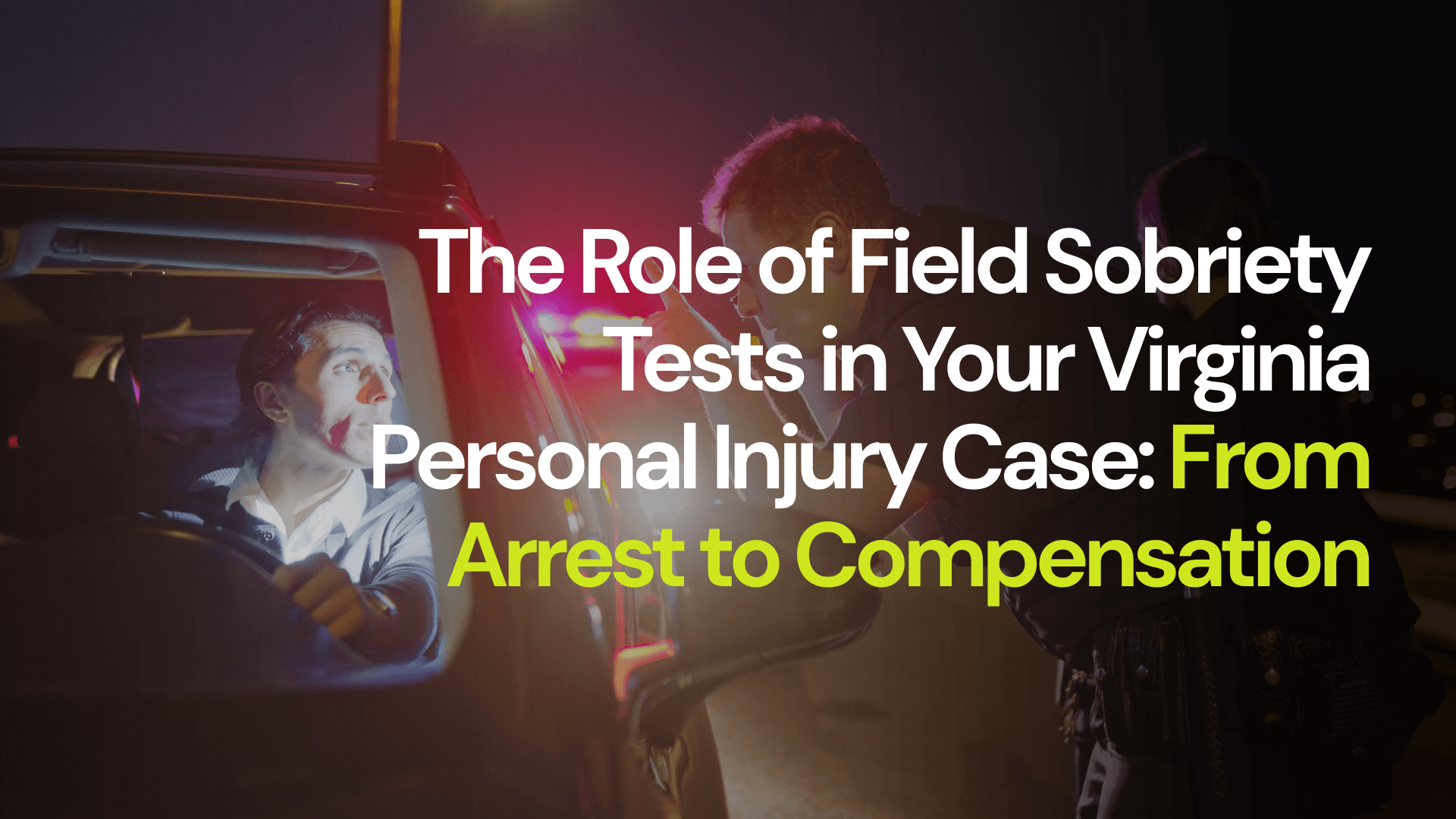
When a drunk driver causes a catastrophic accident in Chesapeake, the immediate focus of law enforcement is the criminal investigation. For the victim, however, the criminal process is only one half of the story. The evidence gathered at the scene—specifically the results of Standardized Field Sobriety Tests (SFSTs)—serves as the bedrock for a successful personal injury lawsuit in Virginia.
In the Commonwealth, proving that a driver was “intoxicated” is not merely about a breathalyzer result. It is about building a narrative of impairment that justifies not only compensatory damages for medical bills but also punitive damages designed to punish the offender. Understanding how these tests work and how they are used in civil litigation is essential for any victim seeking justice in Hampton Roads.
What Are Standardized Field Sobriety Tests (SFSTs)?
The National Highway Traffic Safety Administration (NHTSA) has developed a battery of tests that officers in Virginia are trained to administer. These tests are designed to observe a driver’s balance, coordination, and ability to process multiple instructions simultaneously (divided attention tasks).
In a Virginia personal injury case, the results of these tests provide “visual proof” of impairment that a jury can easily understand, often more effectively than a complex toxicology report.
1. The Horizontal Gaze Nystagmus (HGN) Test
The HGN test is often considered the most reliable of the three. The officer moves an object (like a pen or flashlight) horizontally in front of the driver’s eyes. They are looking for “nystagmus,” which is an involuntary jerking of the eyeball. While nystagmus can occur naturally, it becomes distinct and exaggerated when a person is under the influence of alcohol or certain drugs.
In a civil trial, testimony regarding HGN “clues” is vital. If the defendant’s eyes were jerking before they reached a 45-degree angle, it provides a strong technical basis to argue that their central nervous system was significantly depressed at the time of the crash.
2. The Walk-and-Turn (WAT) Test
This is a “divided attention” test. The driver must take nine heel-to-toe steps along a straight line, turn in a specific manner, and return. The officer looks for eight specific clues, such as:
- Starting before the instructions are finished.
- Losing balance while walking.
- Taking the wrong number of steps.
- Stepping off the line.
For an injury victim, the WAT results are powerful evidence. If a driver cannot walk a straight line on a flat surface in Chesapeake, it stands to reason they were incapable of safely operating a 4,000-pound vehicle at highway speeds.
3. The One-Leg Stand (OLS) Test
The driver is asked to stand on one leg while counting aloud until told to put the foot down. Clues of impairment include swaying, using arms for balance, hopping, or putting the foot down.
Why SFSTs Matter in Virginia Civil Litigation
In many states, a simple DUI conviction might be enough to settle a claim. However, Virginia’s legal system is unique due to its strict adherence to contributory negligence and the high bar for punitive damages.
Overcoming Contributory Negligence
Virginia is one of the few jurisdictions where if a victim is even 1% at fault for the accident, they may be barred from recovering any compensation. By using SFST results to prove the defendant was severely impaired and that the defendant’s conduct was willful and wanton, a lawyer can effectively neutralize the insurance company’s attempts to shift blame onto the victim. The more “clues” of impairment documented at the scene, the harder it is for the defense to argue that the accident was caused by anything other than the driver’s intoxication.
Triggering Punitive Damages under § 8.01-44.1
In Virginia, you can seek punitive damages if the driver’s conduct was “willful or wanton.” While a high Blood Alcohol Content (BAC) of 0.15% or higher is a statutory trigger for punitive damages, SFST results are crucial when:
- The driver refused the breathalyzer.
- The driver’s BAC was below 0.15% but they were still clearly incapacitated.
- The driver was under the influence of drugs that a standard breathalyzer cannot detect.
Detailed officer notes on a “failed” One-Leg Stand or Walk-and-Turn provide the “behavioral evidence” necessary to convince a judge or jury that the driver acted with a conscious disregard for human life.
The “Bodycam” Revolution in Chesapeake DUI Cases
Technical accuracy in a personal injury case has been transformed by the use of police body-worn cameras. In the past, a case relied on an officer’s written report and memory. Today, Nathan Bordegaray prioritizes securing the actual footage of the field sobriety tests.
Seeing a defendant stumble, slur their speech, or fail to follow basic instructions is often the “smoking gun” in a settlement negotiation. Insurance adjusters who might dispute a written report are much more likely to offer a fair settlement when faced with high-definition video of their insured driver failing SFSTs on the side of a road in Hampton Roads.
Challenges to SFST Evidence
It is important to recognize that insurance defense attorneys will attempt to discredit SFST results. They may argue that:
- The road surface was uneven or poorly lit.
- The driver has a physical disability or inner ear issue.
- The officer did not administer the tests according to NHTSA standards.
This is where technical legal expertise becomes a deciding factor. A lawyer must be able to cross-examine the responding officer to confirm that the environment was appropriate for testing and that the “clues” observed were consistent with alcohol impairment rather than physical fatigue or injury from the accident itself.
How to Protect Your Claim After the Crash
If you are involved in a crash where you suspect the other driver is drunk, the moments following the impact are critical for the eventual personal injury claim. While you should never interfere with a police investigation, observing the driver’s behavior and ensuring that the police perform a thorough investigation is vital.
- Notify the Police: Always insist on a police report. Tell the dispatcher if you suspect the other driver is intoxicated.
- Observe the Tests: If it is safe and you are physically able, take note of whether the officer performs the tests described above.
- Identify Witnesses: Bystanders may have seen the driver’s erratic behavior or even seen them stumble out of their vehicle.
The Intersection of Criminal and Civil Law
A common misconception is that if the driver is found “Not Guilty” in criminal court, the civil case is over. This is false. The “burden of proof” in a criminal case is “beyond a reasonable doubt”—the highest standard in law. In a Virginia personal injury case, the burden is a “preponderance of the evidence” (meaning it is more likely than not).
SFST results that might not have been enough for a criminal conviction can still be devastatingly effective in a civil trial to prove negligence and secure compensation for medical expenses, lost wages, and pain and suffering.
Conclusion: Turning Evidence into Justice
The Standardized Field Sobriety Tests performed on the side of a Virginia highway are more than just police procedure; they are the narrative of your recovery. These tests provide the technical details, the swaying, the involuntary eye movements, the missed steps, that transform a simple accident claim into a powerful case for full accountability.
Navigating the transition of this evidence from a police file to a civil courtroom requires a deep understanding of Virginia’s unique evidentiary rules. Without a precise focus on how these tests were administered and recorded, a victim risks leaving significant compensation on the table, especially when it comes to the pursuit of punitive damages.
If you were injured in a drunk driving crash in Chesapeake or Hampton Roads and you want to understand whether punitive damages may apply in your case, contact Bordegaray Injury Law for a Free Consultation.
Call 757-505-HURT (4878) or visit nbinjury.com. At Bordegaray Injury Law, there is No Fee Until We Win.
